
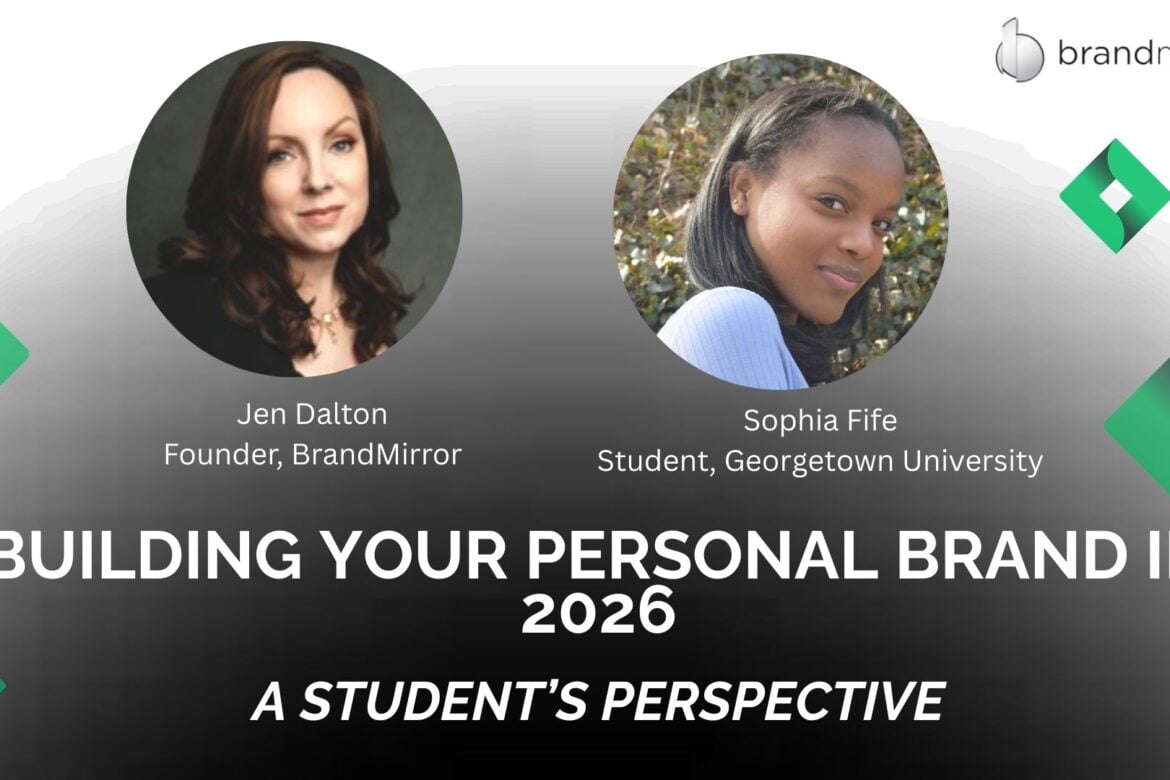
In November 2025, I attended a book talk for Mastering the Corporate Chess Game by Cynthia Groves, where Groves and two of her nine co-authors, Jennifer (Jen) Dalton and ✪ Lizzy Conroy, discussed key principles from the book. After the event, I had the opportunity to connect with Jen Dalton and speak more in depth about her approach to personal strategy and brand building. That conversation later led to my internship at her company, BrandMirror, where I continue to learn directly from her work in brand marketing and consulting. This professional context shaped how I understood the insights Dalton shared at a recent 1 Million Cups Fairfax town hall.
To kick off the new year, Jen Dalton joined entrepreneurs and business owners to discuss the growing importance of personal branding. She began by noting that in the aftermath of COVID, people are increasingly craving humanity and authenticity. At the same time, the rise of AI and automation has pushed many businesses to prioritize convenience at the expense of connection. Dalton emphasized that intentional personal branding – whether through individual outreach or engagement across multiple platforms – plays a critical role in helping people feel seen, respected, and understood. In a rapidly changing marketplace, a strong personal brand is also a key way to adapt to evolving consumer needs. During the talk, Dalton shared five actionable tips for strengthening your personal brand in 2026 that resonated with me.
Tip 1: Be a Curating Champion.
Building a personal brand from scratch can feel overwhelming, which often prevents people from starting at all. Dalton challenged this mindset by asking, “Why do we overwhelm ourselves with the idea of creating?” She emphasized that curating content is just as valuable as creating it. By sharing content from innovative brands or leaders you admire, you strengthen your own brand by demonstrating support for others and building meaningful brand associations. Dalton introduced the 80/20 rule: when starting out in creating a personal brand, 80% of content can be curated, while only 20% needs to be created. Over time, this ratio might change to creating 80% and curating only 20%, but this smooth transition helps prevent burnout, which is increasingly common in professional spaces.
For example, after attending the Mastering the Corporate Chess Game book talk, I could share a quote that resonated with me or repost content from the authors’ platforms – still contributing thoughtfully without the pressure to constantly create something new. Even as I evaluate my favorite brands, a key avenue of audience engagement for them is through TikTok comments. Companies like Duolingo that have blown up from funny or informative comments are benefiting from brand association with personal brands or corporations they agree with, therefore curating their image. Again, when done intentionally, curation is proven to be a powerful form of participation.
Tip 2: Use More Video, Even If You Hate It.
In a world that values authenticity, Dalton highlighted the power of video by sharing a striking comparison: one minute of video can communicate the equivalent of 1.8 million words. Whether it’s an origin story, a short interview, or a 20 second behind-the-scenes moment that doesn’t show your face, video allows people to connect with a brand on a more human level. What stood out most was Dalton’s reminder that not every video needs to be polished or directly promotional. Casual, everyday moments can still communicate values and personality. At the end of the day, the most important part of posting videos is to allow people to get to know you across contexts so they can understand you as a whole person.
I might post about the ridiculously cold weather in Boston or share a reflection on my favorite podcast. One of my biggest lessons from Dalton is that not all content on my page should be promotional; its main goal is to help consumers understand me across contexts and to invite interaction, even if it isn’t directly tied to my work. The familiarity that smaller brands and individuals have been building helps explain why consumers increasingly trust people and small businesses more than large corporations. Research from the Pew Research Center shows that 86% of people trust small businesses and individuals, while only 27% trust larger corporations. But even for bigger corporations, when I think about many of the most effective brands on platforms like TikTok and Instagram Reels, I notice that the videos that go viral are usually funny, reflective, or emotionally engaging rather than product-focused. Clearly, whether in any type of branding, video builds familiarity and trust, helping audiences feel connected to the person behind the brand.
Tip 3: Understand the Power of Collaboration.
Dalton emphasized that collaboration – perhaps through co-authoring content, hosting events, or conducting interviews – offers significant benefits. Collaboration increases visibility, reduces the pressure of producing content alone, and signals an ability to work well with others. Even writing this blog is an example of collaboration, as it extends the reach of Dalton’s ideas to new audiences while also expanding the visibility of my own writing.
This point resonated deeply with me, particularly in the context of a high-achieving academic environment at Georgetown University. At a school full of driven individuals, it can be easy to focus only on what comes next rather than recognizing the value of what has already been accomplished. Group projects, presentations, and case work are often overlooked as meaningful collaborations, even though they reflect valuable teamwork, problem-solving, and intellectual contribution. Dalton’s advice reframes these experiences as opportunities to share work more confidently on LinkedIn, personal websites, or social media platforms. After hearing her speak, I decided to post a school project on my LinkedIn where I conducted management consulting for a non-profit serving almost 30,000 clients (pictured below, client name withheld). I encourage you to do the same.

Tip 4: Value Your Intellectual Property as Business Assets.
Think about all of the content you create for your business or for school: blogs, frameworks, automations, videos…the list goes on. Dalton encourages us to look at these examples not just as outputs, but as assets. Each of these forms of intellectual property supports current workflow efficiency while also contributing long-term value, particularly in the context of future growth or acquisition, and should be leveraged accordingly. Valuable ideas and processes can be trademarked or patented. Think strategically about where you share your assets, accounting for active monthly users across various platforms and where your target audience is most engaged.
Again, in my Georgetown bubble where people don’t tend to spend time appreciating their accomplishments, Dalton’s words caused me to reflect on business ideas developed for class, frameworks built for student organizations, or concepts defined through professional experience that could be valuable assets to me. Additionally, I think about one of the clearest examples of people leveraging their personal brands at Georgetown: NIL (Name, Image, and Likeness) in college sports, where I have seen individuals get compensated sometimes upwards of millions based on the strength and visibility of their personal brands. While most people won’t monetize their brand in the same way, the underlying lesson still applies: your reputation, voice, and values carry real value and should be managed intentionally.
Tip 5: Take a BrandStand, Amplify Your Differentiation.
Dalton closed by encouraging individuals to take a “BrandStand.” Bottom line: don’t be afraid to assert what makes you unique. Purpose-first branding helps people feel connected because it goes beyond surface-level appeal. The brands that resonate most strongly are often those that lead with values, whether through product quality, marketing, or company culture.
After the talk, I reflected more on the brands I feel most passionately about. The common denominator between them is that their mission was clear and consistent throughout every platform; they post funny, thought-provoking TikToks, they release statements when something striking happens in the world, and they show the consumer they care. If two companies are selling the same product, the consumer is far more likely to buy from and defend the ones they feel aligned with personally. I applied this logic to personal branding, where people may appreciate what you do, but lasting impact comes from alignment with who you are and what you represent.
As we enter 2026, Dalton’s insights offer a timely framework for approaching personal branding with clarity and intention. Personal brands have become increasingly influential – often carrying more weight than a traditional résumé alone. Taking the time to evaluate your digital footprint, define your goals, clarify your purpose, and collaborate thoughtfully can help elevate not only your professional presence but also the long-term impact of the work you do.
About the Author
Sophia Fife is a junior at Georgetown University studying Psychology, with minors in Business Studies and Justice & Peace Studies. She is passionate about brand strategy, communications, and consumer behavior, and is currently a Brand Strategy & Research Intern at BrandMirror, where she supports client-facing consulting and internal strategic initiatives. Sophia is especially interested in how values-driven branding and storytelling shape trust, engagement, and long-term impact.
